
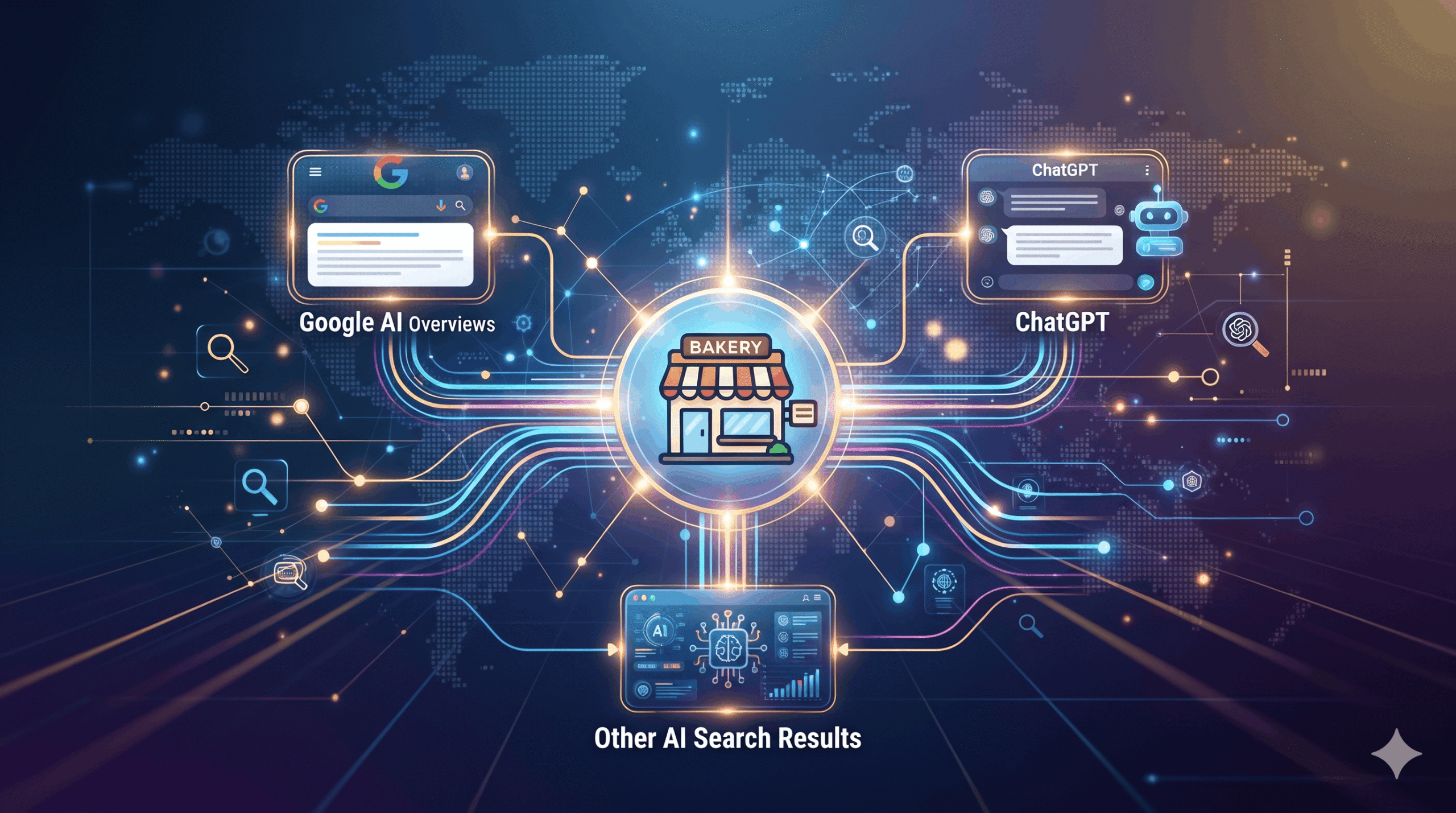
Imagine someone asking ChatGPT, “Can you recommend a reliable digital marketing agency for my small business?” or searching Google for “best website development company near me.”
Instead of browsing through multiple websites, they may receive an AI-generated answer with business recommendations, explanations, and links to relevant sources.
This is changing how customers discover businesses online.
For small businesses, service providers, and startups, online visibility is no longer limited to appearing on Google’s first page. Businesses also need to understand how they can become discoverable through AI-powered search experiences such as ChatGPT, Google AI Overviews, Microsoft Copilot, and other AI search platforms.
This is where AI search visibility for small businesses becomes important.
The good news is that businesses don’t necessarily need an entirely new marketing strategy to adapt. Strong SEO foundations, helpful website content, a trustworthy online reputation, and clear business information can all improve discoverability.
In this guide, we will explain how AI search discovers and references businesses, why traditional SEO still matters, and what practical steps small businesses can take to improve their visibility in AI-generated search results.
What Is AI Search and Why Does It Matter for Small Businesses?
AI search is an approach to finding information where artificial intelligence helps users understand questions and generate answers using information gathered from relevant sources.
Traditional search engines generally present a list of webpages based on a user’s query. AI-powered search experiences can go further by summarizing information, combining relevant sources, and providing direct answers with supporting links.
For example, consider someone searching for: “Which digital marketing services can help a local retail business attract more customers?”
A traditional search engine might show websites about digital marketing services, SEO and advertising. An AI-powered search experience may generate a summarized response explaining different marketing approaches and referencing relevant agencies, guides, and business websites.
This creates another opportunity for businesses to reach potential customers.
Small businesses can benefit from AI search visibility by:
- Reaching customers who use conversational AI tools to research products and services.
- Building brand awareness beyond traditional search engine results.
- Establishing expertise through helpful and informative content.
- Getting discovered for specific industry-related questions.
- Creating additional opportunities to attract relevant website visitors and potential leads.
However, appearing in AI-generated answers is not guaranteed. Each platform uses its own systems to discover, select and present information.
How Do ChatGPT and Google AI Overviews Discover Businesses?
Understanding how AI search discovers information is the first step toward improving your online presence.
Different AI platforms use different technologies and information sources. Some use their own search indexes, while others retrieve information from web search systems or other accessible sources when generating answers.
1. ChatGPT Search
ChatGPT can search the web to provide current information and include links to relevant sources in its answers.
For example, a user might ask: “Recommend some website development companies for small businesses.”
ChatGPT may retrieve relevant web pages and use information from those sources to generate an answer.
For website owners, one important technical consideration is allowing OpenAI’s OAI-SearchBot to access relevant public website content.
Businesses should also ensure their websites contain useful, accurate, and accessible information about their services, expertise, and industry.
2. Google AI Overviews
Google AI Overviews provide AI-generated summaries within Google Search for queries where an AI-generated overview is considered useful.
These summaries can include links to relevant websites that support the information presented. Google’s AI search experiences continue to rely on its core Search systems and established SEO fundamentals.
This means businesses should continue focusing on:
- Creating helpful and reliable content.
- Maintaining technically accessible websites.
- Improving website structure and navigation.
- Publishing relevant information that answers customer questions.
- Following Google’s search guidelines.
There is no separate guaranteed ranking method for appearing in Google AI Overviews.
3. Microsoft Copilot and Other AI Search Platforms
AI-powered discovery is not limited to ChatGPT and Google. Platforms such as Microsoft Copilot and other AI assistants also help users research businesses, compare services, and find answers. The exact sources and selection processes can vary between platforms. This is why businesses should focus on building a consistent and trustworthy online presence rather than relying on a single AI platform.
8 Practical Strategies to Improve AI Search Visibility for Small Businesses
Improving AI search visibility requires a combination of traditional SEO, useful content, technical optimization, and brand-building activities. Here are eight practical strategies that small businesses can implement.
1. Create Helpful and Authoritative Website Content
Content is one of the most important parts of an effective AI search strategy.
AI-powered search experiences need relevant information to answer users’ questions. Businesses that publish helpful, informative, and experience-based content can create more opportunities for their websites to be discovered and referenced. Instead of publishing only promotional content about your products and services, focus on answering the questions your potential customers are already asking.
For example:
A dental clinic can publish articles about dental cleaning, preventive care, and common dental procedures.
A real estate agency can create guides about property buying, selling processes, and local market considerations.
A digital marketing agency can publish practical guides about SEO, website development, and online lead generation.
Useful content ideas include:
- Detailed how-to guides.
- Industry-specific educational articles.
- Frequently asked questions.
- Practical tutorials.
- Case studies and project examples.
- Comparisons of services and solutions.
Include real business experience, examples, and expert insights wherever possible. This helps differentiate your content from generic articles that simply repeat information available elsewhere.
2. Optimize Your Website for Conversational Search Queries
People often interact with AI search tools differently from traditional search engines. Instead of entering short keywords, they may ask complete questions.
For example:
Traditional search: “SEO services Ahmedabad”
Conversational search: “Which SEO services can help a small business in Ahmedabad attract more local customers?”
Your website content should address both types of searches. Consider adding sections that answer questions such as:
- What services does your business offer?
- Who are your ideal customers?
- What problems do your services solve?
- How does your process work?
- What makes your approach different?
- What should customers consider before choosing a service provider?
Use descriptive headings, clear explanations, and relevant examples.
You do not need to create a separate page for every possible question. Instead, organize related questions into useful, comprehensive content. This approach supports both traditional SEO and AI search engine optimization.
3. Build a Strong Online Reputation and Brand Presence
AI search visibility is not only about optimizing your website. Customers often research businesses across several online platforms before making decisions. A consistent and credible presence across relevant websites can help establish your business identity and make it easier for customers to verify your information.
Focus on building your online reputation through:
- Maintaining an accurate Google Business Profile.
- Collecting genuine customer reviews.
- Listing your business in relevant industry directories.
- Publishing expert articles and useful resources.
- Participating in relevant industry discussions.
- Maintaining consistent business information across platforms.
- Showcasing genuine customer testimonials and project experiences.
For example, a local web development company should clearly communicate its services, business location, contact details, experience, and completed projects.
Avoid buying reviews, publishing fake testimonials, or creating artificial brand mentions. The objective is to establish a genuine and consistent digital presence.
4. Improve Your Website Structure and Technical SEO
Even high-quality content needs to be accessible to search engines. If search engines cannot properly crawl, understand, or index your website, your chances of appearing in relevant search results may be limited.
Make sure your website follows essential technical SEO practices. Important areas to review include:
- Website crawlability: Check that important website pages are accessible to search engine crawlers.
- Indexing: Make sure important pages are eligible for indexing and are not accidentally blocked by robots.txt or noindex directives.
- Website navigation: Organize services, products, blogs, and contact information into a clear website structure.
- Internal linking: Connect related articles and service pages to help visitors and search engines discover relevant information.
- Mobile responsiveness: Ensure your website works properly on smartphones, tablets, and desktops.
- Page performance: Improve loading speed and provide a smooth browsing experience.
- XML sitemap: Maintain an updated sitemap to help search engines discover important URLs.
For ChatGPT Search, website owners should also review their robots.txt configuration and ensure OAI-SearchBot is not unintentionally blocked. Technical accessibility does not guarantee inclusion, but it helps make your website discoverable.
5. Use Generative Engine Optimization (GEO) Techniques
Generative Engine Optimization (GEO) refers to strategies aimed at improving the chances of content being discovered, understood, and referenced by generative AI search experiences. For small businesses, GEO should complement traditional SEO rather than replace it.
Some useful GEO practices include:
- Publishing original and experience-based information.
- Answering specific customer questions.
- Organizing content with descriptive headings.
- Explaining industry concepts in simple language.
- Including relevant examples, statistics, and supporting evidence.
- Clearly identifying authors and business expertise.
- Keeping important business information accurate and updated.
- Supporting important claims with credible references.
For example, instead of publishing a generic article titled “Benefits of Digital Marketing,” a digital marketing agency could publish:
“How Can a Local Retail Business Use SEO and Google Business Profile to Attract More Customers?”
The second topic addresses a more specific audience and provides an opportunity to demonstrate practical industry knowledge.
Remember, GEO is not a shortcut to AI rankings. Its value comes from making your website genuinely useful, relevant, and understandable.
6. Establish Topical Authority in Your Industry
Publishing one article about a subject may not be enough to demonstrate your business’s expertise. A better approach is to create a collection of useful resources around topics closely related to your products, services, and industry. This is commonly known as building topical authority.
For example, a website development company could publish articles covering:
- Website development for small businesses.
- Website design best practices.
- WordPress website maintenance.
- Website speed optimization.
- E-commerce website development.
- Website security basics.
- Website redesign considerations.
Connect these articles through relevant internal links.
This helps visitors explore related topics while creating a clearer content structure around your areas of expertise. The same approach can work for accountants, consultants, healthcare providers, real estate agents, and other service-based businesses.
7. Use Structured Data and Clear Business Information
Structured data helps search engines understand specific information about webpages and the entities described on them. For small businesses, relevant schema types may include:
- Organization schema.
- LocalBusiness schema.
- Service schema.
- Article schema.
- BreadcrumbList schema.
For example, LocalBusiness structured data can help communicate information such as business name, address, telephone number, and opening hours when applicable. However, structured data should accurately represent visible website content. It is important to understand that adding schema markup does not guarantee that your business will appear in ChatGPT or Google AI Overviews.
There is no special GEO schema that guarantees AI search visibility. Structured data should be used as part of a broader technical SEO strategy.
8. Monitor Your AI Search Visibility and Improve Your Strategy
AI search optimization should be an ongoing process. Do not assume that publishing an article automatically means your business will appear in AI-generated answers. Regularly monitor how your business is being discovered and referenced.
You can start with a simple monitoring process:
- Search for questions that your potential customers commonly ask.
- Check whether your business website appears in relevant AI-generated answers.
- Look for competitor businesses that are frequently referenced.
- Review which website pages receive organic search traffic.
- Identify content gaps and opportunities to publish more helpful resources.
- Update outdated information and improve existing content.
Useful tools include:
- Google Search Console for organic search performance and indexing information.
- Google Analytics for website traffic and visitor behavior.
- Bing Webmaster Tools for search performance and available AI citation insights.
- Website analytics and relevant third-party AI visibility monitoring tools.
Track meaningful outcomes such as qualified website visits, enquiries, calls and conversions rather than focusing only on how often your brand is mentioned.
SEO vs GEO vs AEO: What Should Small Businesses Understand?
As AI-powered search becomes more common, businesses may encounter three important terms: SEO, GEO and AEO.
Although they are related, they describe slightly different optimization approaches.
| Approach | Meaning | Main objective |
|---|---|---|
| SEO | Search Engine Optimization | Improve visibility in traditional search engines |
| GEO | Generative Engine Optimization | Improve discoverability and references in generative AI answers |
| AEO | Answer Engine Optimization | Make content useful and suitable for direct answers |
For example, traditional SEO may help a service page appear for a search such as “website development company.” GEO focuses on making your business and content discoverable in generative AI experiences. AEO focuses on providing clear answers to specific questions such as “How much does a small business website cost?”
For small businesses, these strategies should work together.
You do not need to abandon traditional SEO to start investing in AI search marketing. A strong SEO foundation provides a useful starting point for broader search visibility.
What Are the Common Mistakes Small Businesses Should Avoid?
While working on AI search visibility, avoid shortcuts that can damage your website’s quality and credibility.
Some common mistakes include:
- Publishing generic AI-generated articles: Using AI tools to create content is not inherently a problem. However, publishing large quantities of generic articles without useful insights or editorial review can result in poor-quality content.
- Ignoring traditional SEO: AI search does not make website optimization, indexing, relevant content, and technical SEO irrelevant.
- Buying fake reviews and brand mentions: Artificial reviews and spammy mentions do not create a trustworthy reputation.
- Overusing keywords: Adding the same keywords repeatedly makes content difficult to read and does not guarantee better visibility.
- Ignoring website technical issues: Blocked crawlers, broken links, poor navigation, and indexing problems can limit discoverability.
- Expecting immediate results: AI search visibility is not an overnight process. Search engines and AI platforms have different discovery and selection systems, and no service provider can guarantee inclusion in their answers.
Focus on building long-term digital credibility.
A Simple AI SEO Action Plan for Small Businesses
If you are just getting started, you do not need to implement everything at once. Use this practical action plan to begin improving your AI search engine optimization.
| Activity | What to do |
|---|---|
| Website audit | Review crawlability, indexing, and mobile experience |
| Business information | Update website contact details and business profiles |
| Content strategy | Publish useful industry-specific articles |
| Online reputation | Collect genuine customer reviews |
| Website structure | Improve navigation and internal linking |
| GEO optimization | Make content clear, useful and experience-based |
| Structured data | Implement relevant schema markup |
| Performance tracking | Monitor organic traffic, enquiries and AI references |
Consistency is more important than trying every new AI SEO tactic available online.
Final Thoughts
The way customers discover businesses online is evolving. People are increasingly using AI-powered platforms to ask questions, research services, compare options, and find solutions. For small businesses, this creates another opportunity to build brand awareness and connect with potential customers.
However, appearing in AI search results is not about finding a secret optimization technique. It starts with the fundamentals: a technically accessible website, useful and authoritative content, a consistent online reputation, clear business information, and a strong SEO foundation.
By combining these practices with a thoughtful Generative Engine Optimization strategy and Search Everywhere Optimization approach, small businesses can prepare for a search environment that extends beyond traditional search engine results.
Start by making your business genuinely useful, credible, and easy to discover. That is the foundation of sustainable online visibility.
If your business is looking to improve its website performance, SEO strategy, and AI search visibility, working with an experienced digital marketing team can help you identify opportunities and build a practical growth strategy.
At RT Technolab, we help businesses strengthen their digital presence through website development, SEO, and digital marketing solutions.



SEO vs GEO vs AEO: What's the Difference and Which Strategy Does Your Business Need in 2027? - RT Technolab
[…] RT Technolab, we help businesses strengthen their digital presence through SEO, digital marketing, and website design and development […]