Search is changing, and businesses can no longer rely only on traditional search engine rankings to attract potential customers. People are increasingly using AI-powered search engines, conversational AI tools, and answer-based platforms to discover information, compare services, and make purchasing decisions.
While Google remains an important source of website traffic, platforms such as ChatGPT, Perplexity, and Google’s AI Overviews are changing how users find and consume information.
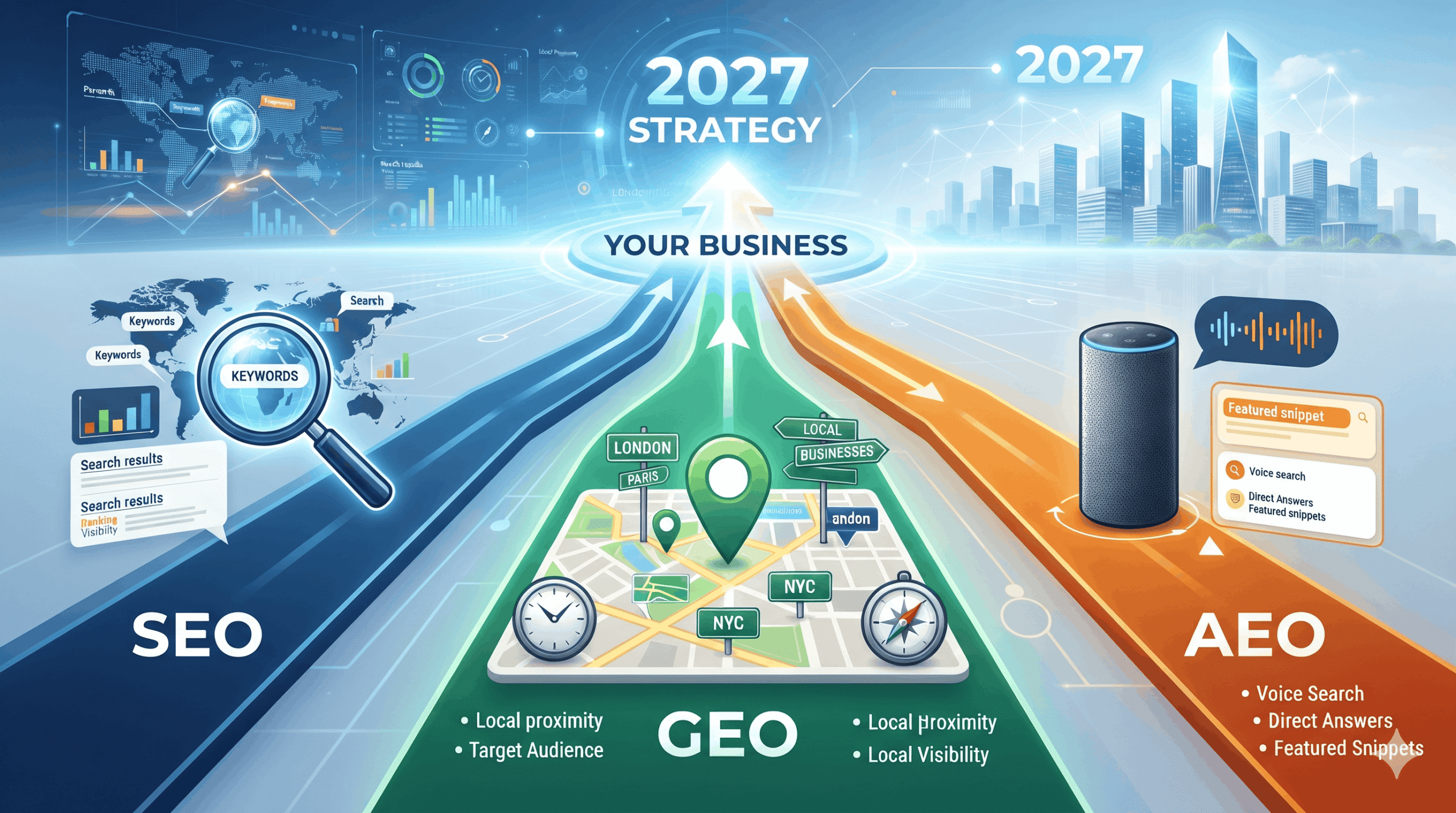
This shift has introduced three important digital marketing approaches: Search Engine Optimization (SEO), Answer Engine Optimization (AEO), and Generative Engine Optimization (GEO).
But what exactly do these strategies mean? How are they different? And should businesses invest in SEO vs GEO vs AEO to improve their online visibility in 2027?
In this guide, we will explain the differences between SEO vs GEO and SEO vs AEO, explore how each approach works, and discuss how businesses can combine all three to build a stronger digital presence across traditional search engines and AI-powered platforms.
What Is Traditional SEO (Search Engine Optimization)?
Search Engine Optimization (SEO) is the process of improving a website’s visibility in organic search engine results. It involves optimizing website content, technical performance, website structure, and backlinks to help search engines understand and rank relevant pages.
For example, when someone searches Google for “best digital marketing agency for small businesses,” SEO helps relevant websites appear in the search results.
Traditional SEO focuses on helping search engines discover, crawl, index, and understand website content so that relevant pages can appear for users’ search queries.
Key Components of Traditional SEO
Some important elements of an effective SEO strategy include:
- Keyword Research: Identifying relevant search terms and understanding what potential customers are searching for.
- On-Page SEO: Optimizing page titles, meta descriptions, headings, URLs, images, and website content.
- Technical SEO: Improving website speed, mobile usability, crawlability, indexing, and site architecture.
- Content Marketing: Publishing useful, informative, and relevant content that addresses customer questions and search intent.
- Link Building: Earning relevant backlinks from trustworthy websites to strengthen website authority.
- Local SEO: Optimizing business listings, local landing pages, and local business information to attract customers in specific locations.
Why Does Traditional SEO Still Matter in 2027?
Despite the growth of AI-powered search, traditional SEO remains an important foundation of digital marketing.
Businesses still need search-friendly websites, useful content, strong technical foundations, and trustworthy information to build online visibility.
Traditional SEO can help businesses:
- Attract relevant organic website traffic.
- Reach customers actively searching for products and services.
- Build brand awareness and credibility.
- Generate qualified leads and business enquiries.
- Establish long-term organic search visibility.
However, search visibility is no longer limited to traditional blue links. Businesses must also consider how their content can appear in direct answers and AI-generated responses.
What Is Answer Engine Optimization (AEO)?
Answer Engine Optimization (AEO) is the process of structuring and optimizing website content to make it easier for search engines and answer-based platforms to identify and present direct answers to users’ questions.
Unlike traditional SEO, which often focuses on improving webpage rankings, AEO places greater emphasis on providing clear, concise, and relevant answers to specific questions.
For example, a user might search: “What is the average cost of website development for a small business?”
Instead of browsing multiple websites, the user may receive a direct answer through a featured snippet, an AI-generated answer, or another answer-focused search feature.
AEO aims to make your content useful and understandable enough to be considered for these answer experiences.
Key Answer Engine Optimization Techniques
Businesses can improve their AEO readiness through several content and website optimization practices:
- Create Question-Based Content: Identify common questions customers ask about your products, services, and industry. Create dedicated sections that answer those questions clearly.
- Use Clear Headings and Subheadings: Organize content using descriptive H2 and H3 headings. This helps readers and search systems understand the purpose of each section.
- Provide Direct and Concise Answers: Answer important questions early in each section before providing additional explanations, examples, and supporting details.
- Add Relevant FAQ Sections: Include frequently asked questions that address genuine customer concerns. Provide accurate and helpful answers instead of repeating keywords.
- Implement Structured Data: Use relevant schema markup, such as Article, Organization, Product, and LocalBusiness, where appropriate. Structured data helps search engines interpret information about your website and business.
- Demonstrate Expertise and Trustworthiness: Publish accurate information, demonstrate subject knowledge, provide author details where relevant, and keep important website information updated.
Why Is AEO Important for Businesses?
AEO helps businesses make their information more accessible in search experiences where users want quick and direct answers.
Potential benefits include:
- Greater opportunities to appear in featured snippets and answer-focused search results.
- Improved visibility for question-based queries.
- Better user experience through clear and organized information.
- Opportunities to build brand recognition.
- Increased accessibility of useful business information.
Importantly, appearing in an AI-generated answer or featured snippet is not guaranteed. AEO focuses on making content easier to understand and potentially use in these experiences.
What Is Generative Engine Optimization (GEO)?
GEO is the practice of improving a brand’s visibility and representation in AI-generated search responses. AI-powered search engines and platforms such as ChatGPT, Perplexity, and Google AI Overviews can generate responses by synthesizing information from different sources.
Rather than simply displaying a list of webpages, these platforms may provide summarized answers, recommendations, comparisons, and references to supporting sources.
GEO focuses on making your website content and brand information clear, credible, relevant, and useful so that AI-powered systems can potentially discover, understand, reference, or mention your business.
For example, imagine someone asks an AI-powered search platform: “Which digital marketing services should a small business invest in to increase online visibility?”
The platform might generate an answer discussing SEO, website development, content marketing, and paid advertising while referencing relevant sources.
A business with helpful content, consistent brand information, and demonstrated expertise may have more opportunities to be discovered or referenced in such responses.
Important Generative Engine Optimization Strategies
- Publish Helpful, In-Depth Content: Create comprehensive content that addresses real customer questions. Include practical advice, examples, comparisons, and relevant industry insights.
- Build Brand Authority: Publish expert-led articles, case studies, industry guides, and educational resources that demonstrate your business’s knowledge and experience.
- Focus on Brand Mentions and Citations: Build a consistent brand presence across relevant industry publications, business directories, authoritative websites, and other trustworthy online sources. Brand mentions and citations can help establish a broader digital footprint. However, not every mention creates an AI citation, and there is no guaranteed formula for AI recommendations.
- Use Clear and Structured Information: Organize website content into logical sections. Use descriptive headings, lists, tables, definitions, and relevant structured data to make information easier to interpret.
- Maintain Consistent Business Information: Ensure that your business name, services, contact information, website details, and company descriptions are accurate and consistent across important online platforms.
- Demonstrate Real Experience and Expertise: Share original insights, practical examples, customer success stories, and genuine industry knowledge rather than publishing generic AI-generated content without meaningful value.
Why Is GEO Important for Businesses in 2027?
As AI-powered search experiences become more common, businesses have an additional opportunity to reach potential customers beyond traditional search engine results.
GEO can help businesses work towards:
- Increasing brand visibility in AI-generated responses.
- Building brand recognition across AI-powered platforms.
- Creating additional discovery opportunities beyond traditional search.
- Establishing authority through useful and credible online information.
- Supporting brand awareness during customer research and comparison.
GEO does not replace SEO. It expands the way businesses think about online visibility.
SEO vs GEO vs AEO: What Are the Key Differences?
Although SEO, AEO, and GEO share the common goal of improving online visibility, they focus on different search experiences.
Here is a simple comparison:
| Comparison | SEO | AEO | GEO |
|---|---|---|---|
| Full form | Search Engine Optimization | Answer Engine Optimization | Generative Engine Optimization |
| Primary focus | Organic search visibility | Direct answers to questions | Visibility in AI-generated responses |
| Main objective | Improve search rankings | Make content answer-ready | Improve brand discovery and representation |
| Content approach | Search-intent-focused content | Clear, concise answers | Context-rich, credible information |
| Common platforms | Google, Bing | Featured snippets and answer-focused search | ChatGPT, Perplexity, Google AI Overviews |
| Key optimization | Keywords, technical SEO, backlinks | FAQs, structured answers, schema | Brand authority, useful content, mentions and citations |
| Desired outcome | Organic visibility and traffic | Answer visibility | AI visibility and brand recognition |
The main difference: SEO helps your website become discoverable in search results, AEO helps your content provide direct answers, and GEO focuses on improving your chances of being discovered or referenced in AI-generated responses.
These approaches overlap, and the same high-quality content can support all three.
SEO vs GEO: How Are They Different?
The biggest difference between SEO and GEO is the search experience they target. Traditional SEO focuses on helping webpages appear in organic search results when users enter relevant queries.
GEO focuses on improving how a business and its content may be discovered, understood, and represented in AI-generated responses.
For example:
- SEO: A user searches “SEO services for small businesses.” Your website aims to appear in the organic search results.
- GEO: A user asks an AI platform, “Which SEO strategies should a small business use?” Your website aims to become a relevant and credible source that the platform may reference.
Traditional SEO places significant emphasis on website rankings, organic clicks, and search traffic. GEO also considers brand mentions, source references, content credibility, and visibility in generated answers.
Businesses should not abandon traditional SEO to focus exclusively on GEO. A technically sound, informative, and authoritative website can support both strategies.
SEO vs AEO: How Are They Different?
SEO and AEO are closely related, but they emphasize different ways of delivering information to users. SEO focuses on improving webpage visibility for relevant search queries, while AEO focuses on making information easier to extract and present as a direct answer.
Consider a dental clinic that wants to attract new patients.
- SEO approach: Optimize a webpage for “best dental clinic in Ahmedabad” and related local search terms.
- AEO approach: Publish clear answers to questions such as “How often should you visit a dentist?” and “What are the benefits of professional teeth cleaning?”
The SEO approach helps the clinic target relevant search results, while the AEO approach makes its educational content more suitable for answer-focused search experiences.
Both strategies can work together to attract potential customers at different stages of their decision-making journey.
GEO vs AEO: Which One Should Businesses Focus On?
GEO and AEO both address the evolution of search beyond traditional webpage listings, but their objectives are not identical.
AEO primarily focuses on providing direct answers to user questions. GEO takes a broader approach by improving brand and content visibility in generative AI experiences.
For example, if someone asks, “What is local SEO?”, AEO-oriented content should provide a clear and direct explanation.
If someone asks, “Which digital marketing agency can help my small business improve local SEO?”, GEO becomes relevant because the AI platform may consider business information, service descriptions, expertise, and external references when generating its response.
Businesses can use AEO to improve the clarity of their information and GEO to strengthen their broader presence across AI-powered discovery platforms.
How Can Businesses Combine SEO, GEO, and AEO in 2027?
The most practical AI SEO strategy for 2027 is not about choosing one optimization method over another. It is about creating a connected strategy that supports visibility across traditional search engines and AI-powered platforms.
Here are six practical steps businesses can follow.
1. Build a Strong Traditional SEO Foundation
Start with the basics:
- Conduct keyword and competitor research.
- Optimize important website pages.
- Improve website speed and mobile usability.
- Fix technical SEO issues.
- Develop a clear website structure.
- Earn relevant and trustworthy backlinks.
Without a strong website foundation, it becomes harder to establish consistent search visibility.
2. Create Content That Answers Customer Questions
Identify the questions your customers ask before choosing a product or service.
Develop blog articles, service pages, FAQs, and educational guides that address these questions.
For example, a website development company could publish content around:
- How much does website development cost?
- What features should a business website have?
- How long does it take to build a business website?
- Should small businesses choose WordPress or custom development?
This approach supports both SEO and answer engine optimization techniques.
3. Optimize Content for Google AI Overviews and Other AI Platforms
Focus on publishing accurate, useful, and well-structured content.
Some Google AI Overviews optimization practices include:
- Providing clear explanations of important topics.
- Using descriptive headings and organized sections.
- Supporting claims with reliable information.
- Demonstrating first-hand experience where possible.
- Keeping website content accurate and updated.
- Following Google’s existing SEO best practices.
There is no special schema or guaranteed optimization technique that automatically secures inclusion in Google AI Overviews. Strong content and technical accessibility remain important foundations.
4. Strengthen Your Brand’s Online Authority
AI search optimization is not limited to publishing more blog posts. Businesses should also work on building a credible online presence.
Consider:
- Getting featured in relevant industry publications.
- Publishing guest articles on reputable websites.
- Maintaining accurate business directory listings.
- Encouraging genuine customer reviews.
- Participating in relevant industry discussions.
- Publishing original research, insights, and case studies.
Consistent brand mentions and citations across credible sources can contribute to brand recognition and help establish a trustworthy digital presence.
5. Improve Website Structure and Content Accessibility
Make it easy for search engines and AI systems to access and understand your website.
Important practices include:
- Maintaining a logical internal linking structure.
- Using descriptive page titles and headings.
- Implementing relevant schema markup.
- Creating an accurate XML sitemap.
- Avoiding unnecessary content duplication.
- Ensuring important content is accessible to search crawlers.
- Maintaining clear organization across service and informational pages.
6. Track Performance Across Different Search Experiences
Traditional SEO metrics alone may not provide a complete picture of your brand’s visibility. Businesses should monitor a broader set of performance indicators.
| Strategy | Important metrics |
|---|---|
| SEO | Organic traffic, keyword rankings, impressions, clicks, conversions |
| AEO | Featured snippet visibility, answer-related search appearances, relevant organic impressions |
| GEO | AI platform mentions, source citations, referral traffic, brand visibility, assisted conversions |
Some AI visibility measurements require manual checks or specialized monitoring tools. There is no single universal measurement standard for GEO or AEO yet.
Which Strategy Does Your Business Need in 2027?
The right approach depends on your business model, target audience, marketing objectives, and current digital presence.
Here is a practical breakdown for different types of businesses.
Small Businesses and Local Service Providers
Recommended focus: SEO + AEO + GEO
Local businesses should begin with local SEO to attract customers searching for nearby services. They can complement this with AEO-friendly FAQs, informative service pages, accurate business listings, and a consistent brand presence to improve their discoverability across AI-powered platforms.
Startups and New Businesses
Recommended focus: SEO + GEO
Startups need to establish brand awareness, build authority, and attract their first customers.
Publishing useful industry content, targeting relevant keywords, developing quality backlinks, and creating a consistent online brand presence can help build a foundation for long-term visibility.
E-commerce Businesses
Recommended focus: SEO + AEO + GEO
E-commerce businesses can optimize product pages, category pages, product descriptions, and buying guides.
Clear product specifications, comparisons, FAQs, customer reviews, and accurate product information can support both traditional search and AI-driven product discovery.
B2B Companies and Professional Service Providers
Recommended focus: SEO + GEO + AEO
B2B buyers often research multiple providers before making purchasing decisions.
Businesses should publish detailed service pages, industry insights, case studies, comparison guides, and answers to common customer questions.
Building authority through credible publications, relevant brand mentions, and informative content can support visibility across different search experiences.
Common Mistakes Businesses Should Avoid When Adopting GEO and AEO
As businesses explore AI search optimization techniques, it is important to avoid practices that focus on shortcuts rather than long-term credibility.
Some common mistakes include:
- Ignoring traditional SEO: GEO and AEO should complement your existing SEO foundation.
- Publishing generic AI-generated content: Content should provide original insights, useful information, and genuine value.
- Keyword stuffing: Repeating keywords unnaturally can damage readability and content quality.
- Ignoring brand authority: A website alone may not communicate the complete picture of a business’s credibility.
- Using irrelevant backlinks: Focus on relevant and trustworthy sources rather than acquiring links in bulk.
- Expecting guaranteed AI visibility: No agency or optimization strategy can guarantee that an AI platform will mention or cite a particular business.
- Ignoring performance measurement: Monitor traffic, conversions, brand mentions, and visibility rather than relying on keyword rankings alone.
A sustainable strategy should prioritize usefulness, accuracy, credibility, and a positive user experience.
The Future of Search: What Should Businesses Expect in 2027?
Search is becoming more conversational and increasingly influenced by AI-powered experiences.
Users are no longer limited to entering short keywords into search engines. They can ask detailed questions, compare different solutions, request recommendations, and receive summarized information.
This creates new opportunities and challenges for businesses. In 2027, businesses should prepare for:
- More Conversational Searches: Users may increasingly use complete questions and natural language when searching for information.
- Greater Importance of Brand Authority: Consistent business information, credible content, and relevant online mentions can help establish a stronger digital presence.
- Changing Organic Traffic Patterns: AI-generated answers may influence whether users click through to websites, making it important to evaluate visibility alongside website traffic.
- More Focus on Helpful Content: Original insights, clear explanations, and practical expertise will remain important for delivering value to users.
- Multiple Search Discovery Channels: Customers may discover businesses through traditional search engines, AI assistants, social platforms, online communities, and other digital channels.
The businesses that adapt to these changes while maintaining a strong SEO foundation will be better positioned to compete for online attention.
Conclusion:
The way people discover businesses online is evolving. Traditional search engines remain important, but AI-powered platforms are creating additional ways for customers to find information, compare services, and discover brands.
SEO vs GEO vs AEO should not be treated as competing digital marketing strategies. They address different aspects of online visibility and can work together as part of a comprehensive approach.
Businesses should focus on building a strong SEO foundation, creating clear and helpful answers through AEO, and strengthening their digital authority through GEO.
Whether you are a startup building your online presence, a small business looking for more customers, or an established company planning its next stage of digital growth, combining these three approaches can help prepare your business for the changing search landscape.
Need help improving your business’s online visibility?
At RT Technolab, we help businesses strengthen their digital presence through SEO, digital marketing, and website design and development solutions.
Visit RT Technolab to explore how a strategic digital marketing approach can support your business growth in 2027.